Because of the wide
range of structural possibilities, this Spotter's Guide shows only
the most common fixed (non-movable) bridge types. Other types are
listed in the Bridge Terminology page. The drawings are not
to scale. Additional related info is found on the other
Terminology pages which are linked to the left.
The four main factors are used in describing a bridge. By
combining these terms one may give a general description of most
bridge types.
- span (simple, continuous, cantilever),
- material (stone, concrete, metal, etc.),
- placement of the travel surface in relation to the structure
(deck, pony, through),
- form (beam, arch, truss, etc.).
The three basic types of spans are shown below. Any of these
spans may be constructed using beams, girders or trusses. Arch
bridges are either simple or continuous (hinged). A cantilever
bridge may also include a suspended span.


Examples of the three common travel surface configurations are
shown in the Truss type drawings below. In a Deck
configuration, traffic travels on top of the main structure; in a
Pony configuration, traffic travels between parallel
superstructures which are not cross-braced at the top; in a
Through configuration, traffic travels through the
superstructure (usually a truss) which is cross-braced above and
below the traffic.


Beam and Girder types
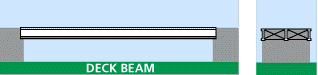
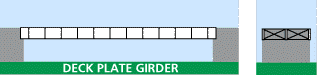
Simple deck beam bridges are usually metal or reinforced
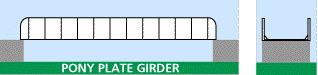
concrete. Other beam and girder types are constructed of metal. The
end section of the two deck configuration shows the cross-bracing
commonly used between beams. The pony end section shows knee braces
which prevent deflection where the girders and deck meet.
One method of increasing a girder's load capacity while
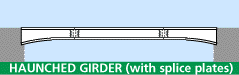
minimizing its web depth is to add haunches at the supported ends.
Usually the center section is a standard shape with parallel
flanges; curved or angled flanged ends are riveted or bolted using
splice plates. Because of the restrictions incurred in transporting
large beams to the construction site, shorter, more manageable
lengths are often joined on-site using splice plates.
Many modern bridges use new designs developed using computer
stress analysis. The rigid frame type has superstructure and
substructure which are integrated. Commonly, the legs or the
intersection of the leg and deck are a single piece which is riveted
to other sections.
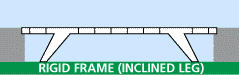
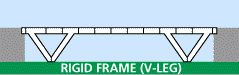
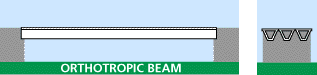
Orthotropic beams are modular shapes which resist stress
in multiple directions at once. They vary in cross-section and may
be open or closed shapes.
Arch types
There are several ways to classify arch bridges. The placement of
the deck in relation to the superstructure provides the descriptive
terms used in all bridges: deck, pony, and through.
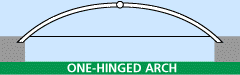
Also the type of connections used at the supports and the
midpoint of the arch may be used - - counting the number of
hinges which allow the structure to respond to varying
stresses and loads. A through arch is shown, but this applies to all
type of arch bridges.

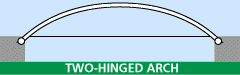
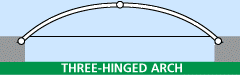
Another method of classification is found in the configuration of
the arch. Examples of solid-ribbed, brace-ribbed (trussed
arch) and spandrel-braced arches are shown. A solid-ribbed
arch is commonly constructed using curved girder sections. A
brace-ribbed arch has a curved through truss rising above the deck.
A spandrel-braced arch or open spandrel deck arch carries the deck
on top of the arch.

Some metal bridges which appear to be open spandrel deck arch
are, in fact, cantilever; these rely on diagonal bracing. A
true arch bridge relies on vertical members to transmit the load
which is carried by the arch.


The tied arch (bowstring) type is commonly used for
suspension bridges; the arch may be trussed or solid. The
trusses which comprise the arch will vary in configuration, but
commonly use Pratt or Warren webbing. While a typical arch bridge
passes its load to bearings at its abutment; a tied arch resists
spreading (drift) at its bearings by using the deck as a tie piece.


Masonry bridges, constructed in stone and concrete, may have open
or closed spandrels A closed spandrel is usually filled with rubble
and faced with dressed stone or concrete. Occasionally, reinforced
concrete is used in building pony arch types.


Truss - simple types
A truss is a structure made of many smaller parts. Once
constructed of wooden timbers, and later including iron tension
members, most truss bridges are built of metal. Types of truss
bridges are also identified by the terms deck, pony and
through which describe the placement of the travel surface in
relation to the superstructure (see drawings above). The king
post truss is the simplest type; the queen post truss
adds a horizontal top chord to achieve a longer span, but the center
panel tends to be less rigid due to its lack of diagonal bracing.


Covered bridge types (truss)
Covered bridges are typically wooden truss structures. The
enclosing roof protected the timbers from weathering and extended
the life of the bridge.
One of the more common methods used for achieving longer spans
was the multiple kingpost truss. A simple, wooden, kingpost
truss forms the center and panels are added symmetrically. With the
use of iron in bridge construction, the Howe truss - - in its
simplest form - - appears to be a type of multiple kingpost truss.
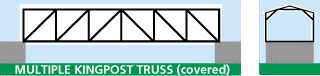
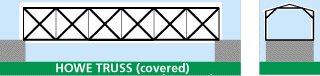
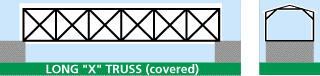
Stephen H. Long (1784-1864) of the U.S. Army Topographical
Engineers may be best known for comments he made after one of his
missions to explore and map the United States as it expanded
westward. In 1819-20, when he viewed the treeless expanse of the
Great Plains, he called it the "American Desert" - - and the name
stuck. While working for the Baltimore and Ohio Railroad, he
developed the X truss in 1830 with further improvements patented in
1835 and 1837. The wooden truss was also known as the Long
truss and he is cited as the first American to use mathematical
calculations in truss design.
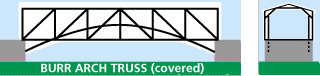
Theodore Burr built a bridge spanning the Hudson River at
Waterford, NY in 1804. By adding a arch segments to a multiple
kingpost truss, the Burr arch truss was able to attain longer
spans. His truss design, patented in 1817, is not a true arch as it
relies on the interaction of the arch segments with the truss
members to carry the load. There were many of this type in the
Pittsburgh area and they continue to be one of the most common type
of covered bridges. Many later covered bridge truss types used an
added arch based on the success of the Burr truss.
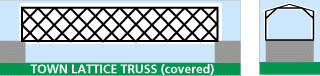
The Town lattice truss was patented in 1820 by Ithiel
Town. The lattice is constructed of planks rather than the heavy
timbers required in kingpost and queenpost designs. It was easy to
construct, if tedious. Reportedly, Mr. Town licensed his design at
one dollar per foot - - or two dollars per foot for those found not
under license. The second Ft. Wayne railroad bridge over the
Allegheny River was an unusual instance of a Town lattice
constructed in iron.
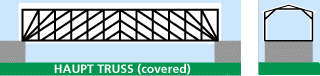
Herman Haupt designed and patented his truss configuration in
1839. He was in engineering management for several railroads
including the Pennsylvania Railroad (1848) and drafted as
superintendent of military railroads for the Union Army during the
Civil War. The Haupt truss concentrates much of its
compressive forces through the end panels and onto the abutments.
Other bridge designers were busy in the Midwest. An OhioDOT web
page cites examples of designs used for some covered bridges in that
state. Robert W. Smith of Tipp City, OH, received patents in 1867
and 1869 for his designs. Three variations of the Smith truss
are still standing in Ohio covered bridges.
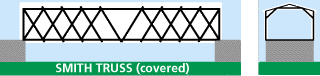
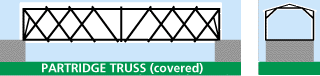
Reuben L. Partridge received a patent for his truss design which
is appears to be a modification of the Smith truss. Four of the five
Partridge truss bridges near his home in Marysville, Union
County, OH, are still in use.
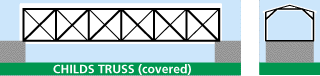
Horace Childs' design of 1846 was a multiple king post with the
addition of iron rods. The Childs truss was used exclusively
by Ohio bridge builder Everett Sherman after 1883.
Truss - Pratt variations
The Pratt truss is a very common type, but has many
variations. Originally designed by Thomas and Caleb Pratt in 1844,
the Pratt truss successfully made the transition from wood designs
to metal. The basic identifying features are the diagonal web
members which form a V-shape. The center section commonly has
crossing diagonal members. Additional counter braces may be used and
can make identification more difficult, however the Pratt and its
variations are the most common type of all trusses.
Charles H. Parker modified the Pratt truss to create a
"camelback" truss having a top chord which does not stay parallel
with the bottom chord. This creates a lighter structure without
losing strength; there is less dead load at the ends and more
strength concentrated in the center. It is somewhat more complicated
to build since the web members vary in length from one panel to the
next.
When additional smaller members are added to a Pratt truss, the
various subdivided types have been given names from the railroad
companies which most commonly used each type, although both were
developed by engineers of the Pennsylvania Railroad in the 1870s.


The Whipple truss was developed by Squire Whipple as
stronger version of the Pratt truss. Patented in 1847, it was also
known as the "Double-intersection Pratt" because the diagonal
tension members cross two panels, while those on the Pratt cross
one. The Indiana Historical Bureau notes one bridge as being a
"Triple Whipple" -- possibly the only one -- built with the thought
that if two are better than one, three must be stronger yet.
The Whipple truss was most commonly used in the trapezoidal form
-- straight top and bottom chords -- although bowstring Whipple
trusses were also built.
The Whipple truss gained immediate popularity with the railroads
as it was stronger and more rigid than the Pratt. It was less common
for highway use, but a few wrought iron examples survive. They were
usually built where the span required was longer than was practical
with a Pratt truss.
Further developments of the subdivided variations of the Pratt,
including the Pennsylvania and Baltimore trusses, led to the decline
of the Whipple truss.


Truss - Warren variations
A Warren truss, patented by James Warren and Willoughby
Monzoni of Great Britain in 1848, can be identified by the presence
of many equilateral or isoceles triangles formed by the web members
which connect the top and bottom chords. These triangles may also be
further subdivided. Warren truss may also be found in covered bridge
designs.


Truss - other types
The other truss types shown are less common on modern bridges.
A Howe truss at first appears similar to a Pratt truss,
but the Howe diagonal web members are inclined toward the center of
the span to form A-shapes. The vertical members are in tension while
the diagonal members are in compression, exactly opposite the
structure of a Pratt truss. Patented in 1840 by William Howe, this
design was common on early railroads. The three drawings show
various levels of detail. The thicker lines represent wood braces;
the thinner lines are iron tension rods. The Howe truss was patented
as an improvement to the Long truss which is discussed with covered
bridge types.


Friedrich August von Pauli (1802-1883) published details of his
truss design in 1865. Probably the most famous Pauli truss,
better known as the lenticular truss -- named because of the
lens shape, is Pittsburgh's Smithfield Street Bridge. Its opposing
arches combine the benefits of a suspension bridge with those of an
arch bridge. But like the willow tree, some of its strength is
expressed in its flexibility which is often noticeable to bridge
traffic.

Before the use of computers, the interaction of forces on spans
which crossed multiple supports was difficult to calculate. One
solution to the problem was developed by E. M. Wichert of
Pittsburgh, PA, in 1930. By introducing a open, hinged quadrilateral
over the intermediate piers, each span could be calculated
independently. The first Wichert truss was the Homestead High
Level Bridge over the Monongahela River in 1937.

The composite cast and wrought iron Bollman truss was
common on the Baltimore and Ohio Railroad. Of the hundred or so
following Wendell Bollman's design, the 1869 bridge at Savage, MD,
is perhaps the only intact survivor. Some of the counter bracing
inside the panels has been omitted from the drawing for clarity.

Also somewhat common on early railroads, particularly the
B&O, was the Fink truss - - designed by Albert Fink of
Germany in the 1860s.

Cantilever types - truss
A cantilever is a structural member which projects beyond its
support and is supported at only one end. Cantilever bridges are
constructed using trusses, beams, or girders. Employing the
cantilever principles allows structures to achieve spans longer than
simple spans of the same superstructure type. They may also include
a suspended span which hangs between the ends of opposing cantilever
arms.
Some bridges which appear to be arch type are, in fact,
cantilever truss. These may be identified by the diagonal braces
which are used in the open spandrel. A true arch bridge relies on
vertical members to transfer the load to the arch. Pratt and Warren
bracing are among the most commonly used truss types.
The classic cantilever design is the through truss which extends
above the deck. Some have trusses which extend both above and below
the deck. The truss configuration will vary.


Suspension types
The longest bridges in the world are suspension bridges or their
cousins, the cable-stayed bridge. The deck is hung from suspenders
of wire rope, eyebars or other materials. Materials for the other
parts also vary: piers may be steel or masonry; the deck may be made
of girders or trussed. A tied arch resists spreading (drift) at its
bearings by using the deck as a tie piece.
Pittsburgh was the site of the earliest wire rope suspension
bridge, the Allegheny Aqueduct carrying the Pennsylvania Mainline
Canal. A similar structure still stands at Minnisink Ford, NY,
crossing the Delaware River. John Roebling and his son Washington
Roebling, later famous in building the Brooklyn Bridge, began their
work in Saxonburg, PA, north of Pittsburgh.





